Showing posts with label Geography. Show all posts

Friday, August 29, 2014

Dead stars Can perform as Supernovas

0 comments

Dead stars Can perform as Supernovas

Astronomers have shown that dead stars known as white dwarfs can re-ignite and explode as supernovas.

The discovery appears to solve a mystery surrounding the nature of a particular category of stellar explosions known as Type Iasupernovas.Theorists suspected that white dwarfs could explode due to a disruptive interaction with a companion star, but lacked definitive evidence until now.

Thursday, August 21, 2014

Geological Backgrounds Of Siberian Traps

0 comments

 Geological Backgrounds Of Siberian Traps

The Siberian Carton is old, cold and thick, unlike the much younger lithosphere of the WSB, which is young, thin and hot. Furthermore, whereas the Carton has remained stable since the Permian (and probably for a long time before that), the Paleozoic surface of the West Siberian Basin has subsided.
Not only has this resulted in deep burial of the basaltic sequences, but it has helped create substantial oil and gas fields - some of the world's largest (Peterson and Clarke, 1991).

Wednesday, August 20, 2014

Wonderful Oceans

0 comments

 Wonderful Oceans


The oceans are unique to our planet. No other planet in our solar system has liquid water. The oceans cover about 70% of the earth’s surface. They contain about 97% of the earth's water supply. Life on earth originated in the seas. The oceans continue to be home to an incredible number of plants and animals.

Monday, August 18, 2014

Rock Cycle

0 comments


 Rock Cycle

 The Rock Cycle describes the process the earth uses to recycle rocks. Yes, even rocks are recycled.
There are three basic types of rocks: igneous, metamorphic, and sedimentary. The interesting part of knowing these names is that any one of the three types of rock can be changed into one of the other types.
The names of the rock types refer to the way the rocks are formed. Igneous rocks are formed from fiery molten magma. Metamorphic rocks form under intense heat and pressure. Sedimentary rocks form by weathering.                                      
Let’s take a closer look at each type.
Igneous Rocks
Igneous rocks are formed of magma, the molten form of the earth’s mantle layer. Igneous rocks can form above ground as lava spewing from volcanoes. But igneous rocks can also form below the surface.

Sunday, August 17, 2014

Fundamentals Of Cyclones

0 comments

Fundamentals Of Cyclones

Cyclones are areas of low pressure. Cyclones usually exhibit nearly circular isobars. If isobars are oblong or elongate with the lowest pressure near the center we call them troughs. As air enters an area of low pressure from all directions, the Coriolis effect bends the direction of the wind to the right of its path. This creates a counterclockwise rotation around the low and  convergence near the center of the system. As the air collides near the center it is forced aloft where divergence takes air away from the center of the system. The upper-level divergence is necessary for the system to be maintained as an area of low pressure. Without the divergence, the system would fill with air and the horizontal pressure differences would be equalized causing the system to dissipate.  

Friday, August 15, 2014

Physical Geography and It's Branches

0 comments

Physical Geography

The natural environment is the primary concern of physical geographers, although many physical geographers also look at how humans have altered natural systems. Physical geographers study Earth’s seasons, climate, atmosphere, soil, streams, landforms, and oceans. Some disciplines within physical geography include geomorphology, glaciology, pedology, hydrology, climatology, biogeography, and oceanography.

Geomorphology is the study of landforms and the processes that shape them. Geomorphologists investigate the nature and impact of wind, ice, rivers, erosion, earthquakes, volcanoes, living things, and other forces that shape and change the surface of the Earth.

Air Masses

0 comments

Air masses and their sources

Air masses bring variety of weather. Six basic types of air masses affect the weather of the British Isles. They can bring anything from tropical warm and humid days to arctic cold depending on the type of air mass. Fronts form the boundaries of air masses with differing properties. The most severe weather usually occurs when dry-cold continental polar air clashes with warm-humid maritime tropical air.

Air masses over Britain The term 'air mass' was introduced some 70 years ago by Norwegian meteorologists from Bergen, Norway. Air mass is a large body of air, whose properties - temperature, humidity and lapse rate - are largely homogeneous over an area several hundred kilometres across.


The nature of air masses is determined by three factors: the source region, the age and the modifications that may occur as they move away from their source region across the earth's surface.


Metamorphic Rock

0 comments

World  Metamorphic Rock Regions


 A high-grade metamorphic rock is one that formed at a depth of tens of kilometers and later returned to the surface. Hence, metamorphic regions are also regions of former or recent intense orogeny. More-stable regions of Earth’s crust tend to be covered with sediments, and only deep drilling will reveal the metamorphic rocks below.

Fundamentals Of Remote sensing Sensors

0 comments

Fundamentals Of Remote Sensing Sensors

Terminology

Range
Every sensor is designed to work over a specified range. The design ranges are usually fixed, and if exceeded, result in permanent damage to or destruction of a sensor. It is customary to use transducing elements over only the part of their range where they provide predictable performance and often enhanced linearity.

Thursday, August 14, 2014

The Geographical View of the Middle East

0 comments

The Geographical View of the Middle East

Map of the Middle East
The Middle East is a large and diverse geographical area located in southwest Asia and northeast Africa. It extends over 2,000 miles from the Black Sea in the north to the Arabian Sea in the south, and about 1,000 miles from the Mediterranean Sea in the west to the mountains of Iran. The term “Middle East” came into common use in the early twentieth century, but remains loosely defined.

Mysteries Continues in Mid-Ocean Ridge

0 comments

What Is The Mid-Ocean Ridge?

The mid-ocean ridge  system is the most extensive chain of mountains on earth,
Bathymetric map showing a global view of the mid-ocean ridge (MOR).
but more than 90% of this mountain range lies in the deep ocean. The mid-ocean ridge wraps around the globe for more than 65,000 km like the seam of a baseball. The average depth to the crest (top) of the ridge is 2500 m, but it rises above sea-level in Iceland and is more than 4000 m deep in the Cayman Trough. Mid-ocean ridges are geologically important because they occur along the kind of plate boundary where new ocean floor is created as the plates spread apart. Thus the mid-ocean ridge is also known as a "spreading center" or a "divergent plate boundary." The plates spread apart at rates of 1 cm to 20 cm per year. As oceanic plates move apart, rock melts and wells up from tens of kilometers deep. Some of the molten rock

Wednesday, August 13, 2014

Vector And Raster

0 comments

VECTOR AND RASTER  

Advantages and Disadvantages


There are several advantages and disadvantages for using either the vector or raster data model to store spatial data. These are summarized below.

Components of a GIS

0 comments


Components of a GIS

A working GIS integrates these five key components: hardware, software, data, people, and methods.


H a r d w a r e
Hardware is the computer on which a GIS operates. Today, GIS runs on a wide range of hardware types, from centralized computer servers to desktop computers used in stand-alone or networked configurations.

Tuesday, August 12, 2014

Atoms and Compound of Minerals

0 comments


Atoms and Compound of mineral  


Atoms are the smallest fraction of an element that can exist, and still show the characteristics of the element. Atoms themselves are composed essentially of electrons (1 negative charge), protons (1 positive charge), and neutrons (no charge). In a simplistic way we can visualize atoms as consisting of a nucleus with protons and neutrons that is surrounded by electrons for charge balance. Atoms of different elements are distinguished by the number of protons in the nucleus.  Hydrogen has the simplest (and  lightest) atom with just one proton and one electron, and then complexity gradually increases until we get to Uranium with 92 protons, 146 neutrons, and 92 electrons. 

The Earth Interior

0 comments

The Earth’s Interior

Studying the earth's interior can help us to understand earthquakes, volcanoes, plate tectonics and more about the inner earths natural processes.
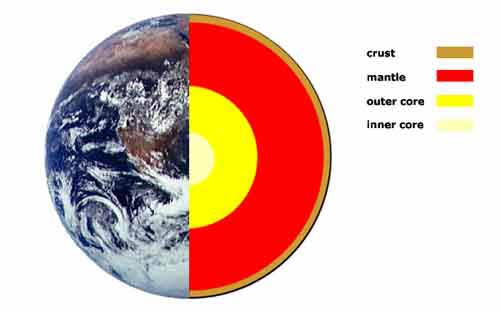
In general the earth's interior has been sorted by Gravity. Heavier elements like iron tend to sink toward the center or core of the earth. Lighter materials, the silicates, oxygen compounds and water have risen to become part of the crust. This action has created distinct layers within the earth and is still in process today.

The Inner Earth is composed of three main parts; the crust, the mantle, and the core as shown in the diagram of the earth's interior below:

Satellites and sensors

0 comments


Satellites and Sensors

A satellite is an object that moves around
a larger object. Earth is a satellite because
it moves around the sun. The moon is a
satellite because it moves around Earth.
But here we are referring to “human-made”
satellites. These objects are launched into space and orbit Earth, or another body in space, and carry instruments for collecting information and communicating it back to the earth

Monday, August 11, 2014

Rocks,Minerals,And Elements

0 comments

 Rocks, Minerals, And Elements


It is best if we clearly define what we are talking about when we discuss rocks, minerals and elements.

Elements:

Elements are atoms, the smallest piece that we can split matter into (except for subatomic particles and other things that we'll leave to the physicists). Different elements have different properties. Take two different elements: iron and helium. Iron is very different than helium. You wouldn't fill a balloon with iron any more than you would try to build a bridge out of helium.

Marine Pollution

0 comments

Marine  Pollution

A staggering amount of waste - much of which has only existed for the past 60 years or so - enters the oceans each year.


Over 80% of marine pollution comes from land-based activities.

From plastic bags to pesticides - most of the waste we produce on land eventually reaches the oceans, either through deliberate dumping or from run-off through drains and rivers. This includes: